Chronic neck pain can make everyday activities difficult, especially when turning your head becomes uncomfortable or your range of motion is limited. When conservative treatments haven’t provided enough relief, you may find yourself considering more invasive procedures.
That was the situation for one patient who came to our clinic, LaserTech Pain and Back Relief Center in Scottsdale, Arizona. After two pain management doctors recommended nerve ablation, he wanted to explore a less invasive option to help relieve his chronic neck pain and restricted neck movement.
Here’s the patient’s testimonial:

Here’s A Quick Summary of How We Tackled this Neck Pain at Our Clinic in Scottsdale
Dr. Craig Zimmerman (Dr. Z) evaluated the patient’s condition and history. Then he created a custom treatment plan that addressed several contributing factors, including spinal health, nerve function, muscle tension, posture, and movement patterns.
After about six treatments, the patient began noticing improvement. By the end of care, he reported almost no pain and nearly full range of motion.
Keep reading for a full breakdown of how Dr. Z approached this patient’s neck pain and the treatments he used to help improve his mobility.
The Challenge: Chronic Neck Pain and Difficulty Turning His Head
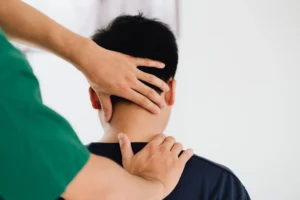
The patient was experiencing chronic neck pain, plus a significant limitation in his ability to turn his head. The restricted mobility was more than just a literal pain in the neck. It was affecting nearly every aspect of his life. When you can’t move your neck, everyday tasks like driving, showering, playing with your kids or grandkids, and getting any work done are so much more difficult than they need to be.
Two pain management doctors had recommended nerve ablation, a procedure that targets specific nerves carrying pain signals. While nerve ablation can be beneficial for some, it’s still considered mildly invasive, requiring needles and a local anesthetic to administer. More concerning, it does nothing to fix the root cause of the problem. By design, nerve ablation only masks pain signals, failing to actually heal anything. For these reasons, this patient wanted to look into whether another approach could help. He came to LaserTech looking for an alternative.
Chronic neck pain can have a lot of different causes. Depending on the individual, symptoms may involve the cervical spine, discs, joints, nerves, muscles, and surrounding connective tissues. Posture, movement habits, and prolonged muscle tension may also influence how comfortably someone moves.
Identifying these factors is an important first step in relieving neck pain and can help guide a treatment plan tailored to the patient’s symptoms, clinical findings, and goals.
The Treatment Plan: Addressing Multiple Factors Contributing to Neck Pain
Dr. Zimmerman took a multi-faceted approach to this particular patient’s care. Rather than focusing exclusively on just masking the pain, Dr. Z leaned on his expertise in treating chronic pain. He incorporated several modalities intended to work together to address the patient’s spinal condition, joint health, nerve function, muscle tension, and restricted movement.
The treatment plan included non-surgical spinal decompression, laser therapy, Electronic Nerve Biomodulator (ENB) therapy, radial pressure wave therapy, and movement-focused techniques.
Each treatment had a different purpose within the overall plan to treat the root cause of the pain, not just the symptoms alone.
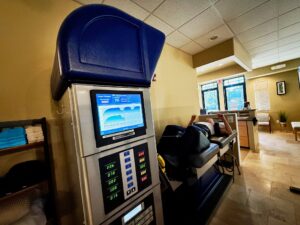
Non-Surgical Spinal Decompression for Spinal Stenosis
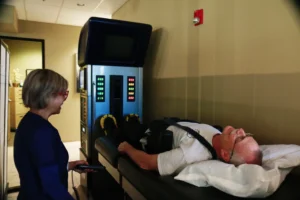
Dr. Z used non-surgical spinal decompression to address the patient’s spinal stenosis.
Spinal stenosis occurs when spaces within the spine narrow, potentially putting pressure on nearby nerves and other structures. Depending on its location and severity, it can contribute to pain, stiffness, and mobility limitations.
Spinal decompression uses controlled traction to apply a stretching force to the spine. For appropriately selected patients, it may be used as part of a non-surgical treatment plan for certain spinal conditions.
In this case, decompression was one component of a broader approach that also addressed the patient’s soft tissues, nerve function, posture, and movement.
Laser Therapy to Support Joint Health
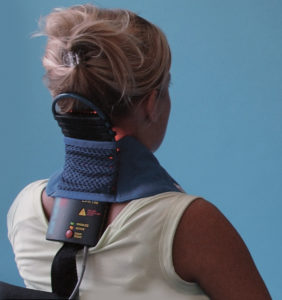
Dr. Zimmerman incorporated LaserTech’s Computerized Multi-Laser Therapy (CMLT) system into the patient’s treatment plan to address damaged joints.
The CMLT system uses low-level cold laser therapy, which delivers specific wavelengths of light to targeted tissues without incisions or needles. This approach, known as photo bio-modulation, is designed to stimulate cellular responses that may support tissue recovery and help manage pain.
LaserTech uses multiple laser wavelengths and a layered absorption process as part of its treatment approach. The goal is to address affected tissues while supporting circulation and the body’s natural healing processes.
Electronic Nerve Biomodulator Therapy to Address Nerve Function
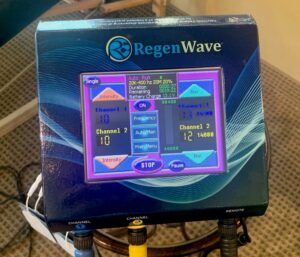
Dr. Z also incorporated Electronic Nerve Biomodulator (ENB) therapy into the patient’s care.
LaserTech uses ENB technology with the goal of modulating nerve transmission and supporting nerve function. It was included in this patient’s treatment plan as one component of a broader approach to managing his symptoms.
Nerves play an important role in transmitting sensory information and coordinating the body’s responses. However, the factors contributing to chronic pain differ from person to person, so treatment selection depends on the individual clinical evaluation.
In this case, Dr. Zimmerman combined ENB with spinal decompression, laser therapy, soft-tissue treatment, and movement-focused techniques to address different aspects of the patient’s presentation.
Radial Pressure Wave Therapy (Shockwave Therapy) for Muscle Tension and Soft-Tissue Restrictions
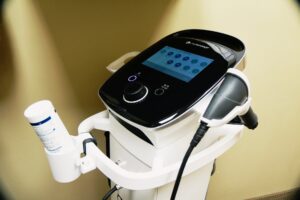
Dr. Zimmerman also used radial pressure wave therapy, a.k.a. shockwave therapy, to address muscle tension and soft-tissue adhesions.
Prolonged muscle tension and restricted tissue mobility can contribute to discomfort and make movement more difficult. Radial pressure wave therapy delivers acoustic pressure waves to targeted tissues and may be used as part of a treatment plan for selected musculoskeletal conditions.
For this patient, Dr. Z used the technology alongside trigger-point treatment and techniques addressing broader fascial tissue pathways.
The goal was to help reduce tissue tension and support more comfortable movement.
Improving Neck Range of Motion: Looking Beyond Pain Relief
Reducing pain was only part of the goal. Dr. Zimmerman also worked on the patient’s limited range of motion, posture, movement patterns, sensory processing, and muscular support to help improve his range of motion.
Correcting the Posture That Restricted Neck Movement
Dr. Z noticed that because the patient had been dealing with neck pain and tension for so long, he’d started compensating for it with a posture that caused his chin to point upward, placing his neck in an extended position. This positioning can influence how the cervical joints move and may restrict comfortable movement in certain directions.
Dr. Zimmerman explained how the patient’s posture could contribute to his limited mobility and showed him how to correct it. As the patient learned to adjust his positioning, he could move from a better starting position, allowing more room for neck movement. Helping him understand how his posture influenced his mobility and giving him practical ways to change it was a crucial piece of his neck pain and mobility treatment.
Using Graded Motor Imagery and Mirror Therapy
Getting this patient to turn his head more comfortably meant looking at more than just the physical tension in his neck. Dr. Z also wanted to help him feel more comfortable with movement.
He used Graded Motor Imagery (GMI), which helps people practice movement in stages, starting with visualization. With mirror training, the patient could also watch and practice movements in a different way. The goal was to help him move more comfortably instead of constantly fight the natura coping mechanisms his body had learned to fight against himself.
Dr. Z also introduced a breathing technique paired with movement to help the patient manage stress-related tension. Sometimes, improving mobility means working on more than the muscles and joints themselves.
Improving Muscle Support and Releasing Tension
Dr. Z also used Muscle Activation Technique to help improve the support his muscles provided while moving. He worked on trigger points and areas of tight connective tissue, using hands-on techniques and shockwave therapy to help release tension and improve mobility.
He also helped the patient recognize how his posture was limiting his neck movement and showed him how to correct it. Rather than focusing on one sore spot, Dr. Z worked on several things that could be making it difficult for the patient to turn his head. The goal was to help him move more comfortably by addressing muscle tension, posture, and movement together.
The Results: Almost No Pain and Nearly Full Range of Motion
The patient began noticing improvement after just about six treatments. By the end of care, he reported almost no pain and nearly full range of motion. In his review of LaserTech, the patient described Dr. Zimmerman’s detailed explanations, his willingness to adapt treatment, and the combination of techniques used to address his limited mobility. He also praised the staff for making him feel comfortable throughout the process.
The outcome addressed the two main concerns that brought him to LaserTech: chronic neck pain and difficulty turning his head.
Every patient’s condition and response to treatment are different, and of course, one person’s results can never predict another’s. However, this case is a perfect example of why it’s so important to look at the whole picture and evaluate all of the factors contributing to chronic neck pain when treating a person, rather than just using the same blanket treatment on everyone that only addresses the symptoms.
Noninvasive, Wholistic Neck Pain Relief in Scottsdale
If chronic neck pain or stiffness is making it difficult to turn your head, work comfortably, or participate in everyday activities, a professional evaluation can help you better understand what may be contributing to your symptoms.
At LaserTech Pain and Back Relief Center in Scottsdale, Dr. Zimmerman uses a combination of non-surgical treatment technologies and supportive therapies to develop individualized care plans. Depending on the patient’s condition, treatment may include spinal decompression, laser therapy, radial pressure wave therapy, and movement-focused techniques.
Not every treatment is appropriate for every patient. An evaluation helps determine which approaches may be suitable based on your symptoms, health history, and treatment goals.

Looking for neck pain treatment in Scottsdale?
Reach out to LaserTech Pain and Back Relief Center to schedule a free consultation and discuss your options with Dr. Zimmerman.